Thursday, October 17, 2013

The Banlieue of St.-Denis

The Chorus of St.-Denis in its Basilica

A detail, Moses Revealing the Tablets of the Law, from the stained glass of Abbot Suger, c. 1145, in the chevet of the royal abbey basilica, now made the cathedral of the diocese.

As a student, of all the wonders of Paris (apart from the Louvre) the one I most wanted to visit was the Basilica of St.-Denis.  Of all the subjects that Erwin Panofsky had brought to life for me, it was the one that had taught me most effectively that there was more to the Middle Ages than Eleanor of Aquitaine and the Four Kings, more to history than Agincourt in technicolor.
Getting there is not difficult: just take the Métro to the end of the line and exit into a modern banlieue that certainly would appall Abbot Suger.  Outside of the walls of Paris, no longer standing, in the middle ages well out in the country, in the summer of 2000 I found a square with ordinary buildings, with ordinary people shopping (such as the photographer Doisneau loved to photograph), with a small carousel brought in for small children, and at one side of this space the Basilica of St.-Denis which enshrines not only the tombs of the Kings of France but, unless you want to quibble on scholarly details, the creation of the Gothic architecture, including its glass and sculpture, of the Ile de France.  Viollet-le-Duc badly damaged the sculptures of the façade, as the drawings by Montfaucon show, but the twelfth-century choir, the ambulatory, and the apse figure in every serious textbook of the history of western art.
Bibliography on Suger and on the Basilica comes in multi-volumed publications, and this is no place to rehearse it; I'll provide a few titles at the end.

Occasionally, on the public service TV channel, CAS (Classic Arts Showcase), I have seen a 1992 performance by the Chorus of St.-Denis with Jean-Claude Casadesus conducting the Lille Orchestra of the In Paradisum from Gabriel Fauré's Requiem.  It is one of many good performances, but it was recorded with the chorus in the choir of its Basilica.  The photographers have taken the occasion to photograph the famous 12th-century stained glass windows of Abbot Suger behind the choristers (and at the end of the recording to show the praying hands of one of the royal gisants), including CIVITAS IERUSALUM: the City of God of Augustine, the Paradise of Dante.  There is also a pane showing Suger himself, so labeled, holding one of the Tree of Jesse windows, though these are not so relevant to the In Paradisum (Googling St.-Denis brings up Suger, but also many other varied images).  Searching on line yields only the out-of-print (and expensive) recording of this performance, but only VHS; as often, the Fauré is paired with Poulenc's Gloria, and I don't know whether the whole Fauré Requiem is included in full.  What I do know is that it presents, I think, the truest images of what Suger meant and, in making skeletal supports and luminous colored glass replace a solid wall with windows, what his architect created.

Now, whether you like Fauré's work or not, it does shimmer, in ineffable glory, and the chorus, mostly young (but not children),  are both as magically earthly and as holy as the singing angels at the Nativity by Piero della Francesca in the National Gallery in London.  In both cases, they remind me of the pseudo-Areopagite's neo-platonic vision of the divine pervading, unifying the material and the divine.  The St.-Denis choristers have rather plain robes, and their hair is not elaborately dressed for the camera.  Even the photography is not pretentious and is not over-produced.  So, when they sing "Jerusalum, Jerusalem" it rings true.  It is the best photographic record of the chevet and a fine performance of the Requiem, too.

I have looked everywhere for really good images of the glass (the ribbing of the chevet, too, really wants good architectural video, though if you have been there you can think your way around it), in particular the beautiful colors of the glass as when you see light coming through them, but the only good photo I could find that I wasn't sure was copyright is the Moses at the top of this post.  And Abbot Suger would want some time to embrace his basilica and its domain as it is today.  But it does glorify all the history that it has lived through.

Besides the basic histories of western architecture (I like Pevsner and especially Kostof), the essential article is Panofsky's Introduction reprinted in Meaning in the Visual Arts, pp. 108–145.  The present edition of the PB, in print for more than half a century, is U. of Chicago Press.  You might as well use the Wikipedia for databank purposes.

I'd be very grateful if someone knows of a CD copy of the VHS cited.


Sunday, August 25, 2013

Significant Form, a century later

Significant Form, a century later
(Kenneth Clark, b. 1903, was the youngest writer on art to embrace as a matter of course the formal assumptions thad had been new when he was a child, but the 1950s had the beautiful dust jackets).
A snapshot off the dust jacket of my 1951 favorite Kenneth Clark, of my favorite painter
Preface
A couple of weeks ago, in eMail, a follower of my blogs and I were discussing what Style means to us.  I suggested that, besides verbal and mathematical communication, both of which manifestly want specific innate gifts, so that the verbal requirement of Scientific American, for instance, makes for tormenting prose and, similarly, Brian Greene, to name one, is tempted to use inadequate and even misleading kinds of animation, in an effort to make quantum theory and its progeny intelligible to the innately non-mathematical.  Since I had to work hard just to pass secondary-school math courses, except for plane geometry, I am grateful, but their efforts just don't work ("slices of bread", indeed!).
But, regarding the mathematical as a language (forget the etymology, lingua), with it and verbal largely excluding each other, don't we have a third language, the aesthetic, by which (this time, mind the etymology rigorously, aisthanomai, covering knowledge by the senses), isn't what we know from music and the visual arts communicated and properly known thereby?  In subsequent eMail we agreed that they all required educating, but (it was I who insisted most, remembering my limitations when it came to quadratic equations, for example) we all are innately gifted differently.  At the same time as that correspondence occurred, I was working to understand Greek Revival in America, and scouring my bookcases to locate my books from the early paperback generation, the ones that had impressed me then, by Geoffrey Scott, Rudolf Wittkower, and Anthony Blunt, besides Erwin Panofsky.  Bernard Berenson could no more be avoided, either, any more than Trinity College and formative Bloomsbury (thank goodness for Leon Edel).  Soon I realized that I needed to write this Post before the architectural one and place it in the Opera Nobilia blog rather than the Essays, where I already have posted any number of houses.

Clive Bell (1881–1964)
It was not only that I had been told, too many times, that I must read Roger Fry, but I'd tried and I detested him, not because he was older (b. 1866) or that I disagreed with everything he said (not everything) but because he ranted, ranted terribly, and argued like a stuntman (in my opinion).  But Virginia Woolf mocked Clive Bell, and half a century ago I half believed her, though I knew that Lytton Strachey was to be read for his prose.  So, while I was in art school, I picked up the thin cream-and-turquoise Penguin PB of Clive Bell's Civilisation and loved it.  In fact, I read him before any of Virginia Woolf.  Yet she more than any of the others was the one who kept me from any more of his, and, not least, his early Art (1913 or 1914, depending on the edition).  So now Project Gutenberg supplies it in your choice of download formats, free of charge.  These data are important, for this is the pre-World War I book, the one (see the footnotes) that shows that Bell had seen only several early Cubist paintings in the second "Post Impressionism" exhibit in London yet even so instantly realized that original cubism, for all its unaccustomed appearance, possessed Significant Form, while the paintings by Cubist followers were as dead as any other derivative works.
Bell had worked closely with Fry on the catalogues for the two "Post Impressionism" exhibits at the Grafton Galleries, and it was he who suggested, faute de mieux on the catalogue the label "Post Impressionist", which has bedeviled us ever since, though the catalogue had to go to the printer, and no one else had thought of a preferable one.  More important, just after the second exhibition, he coined the term Significant Form, which caught on immediately, and, as my generation knows, did endure until, I would say, Pop Art and other post-Modern took over.  The first two chapters of Art are devoted to Significant Form, as such.  Note that I give it uppercase initials but not quotation marks; as a label it is itself significant, whereas "Post Impressionist" is not, and was never meant to be.
So it happened that today, nearly 80, I am reading the seminal work—that is, the first two of five parts are seminal; Part III is awfully Roger Fry-ish, and I have yet to read IV and V.  For the moment, I can wholeheartedly recommend the Introduction and I and II.  Everyone had to admire the serious logic and earnest integrity of this work.  As for that alarming part III, here I find all the wild biases that would have astonished Wölfflin as much as me, today.  I have scanned just enough of Roger Fry, now, to know that his was the virus.  It was Fry that made my most beloved professor teach us that we needn't trouble ourselves much about Praxiteles, for example.  But I have not the slightest trouble with the importance of Significant Form, and Bell, himself, repeatedly says that great artists are, singly, just as holy as those working in the times and places that he follows Fry in elevating.  I suppose we'd be just in regarding those Cambridge Trinitarians as we do any coterie of the young.  That doesn't make them altogether wrong, really; they just needed to get off their high horse, and we, for our part, are enlightened by reading what they actually thought a century ago.  They cannot be blamed for textbooks like Herbert Read's.
Why seriously defend Significant Form?  Because, like any verbal or mathematical sign, form does signify.  Because it is not the representation or the symbolic / allegorical or the moral or ethical, let alone political, reference but the Form that conveys Signification, just as in music.  If one musician, say André Rieu, evokes romantic sentiments and another with the same musical score evokes only what no picture or poem can convey (otherwise, why own several recordings of Debussy Preludes, for example, of which the best ones themselves differ but only in ways that only listening can perceive?  Why treasure dozens of Schubert Winterreise, all with the same notes and the same words, and not just for the human voices, though the voice may tell us more than anything else what the musicians' mind and soul understood in that performance of the song cycle?)—then it can only be that in each the Significant Form is the language that speaks to us, if we have learned that language well enough.  As early as the 1980s I began to hear, in reviews of Fine Arts students' work, complaints that the work was too "merely formal", as if Form were merely Basic Design, and ask the students why his work did not mean anything.  The teachers made clear that they sought a gender or political or religious or symbolic meaning, precisely what I'd been taught was extraneous, though not per se damning.  Also, I began to sense that by expressing oneself they meant something quite different from the self that Clive Bell (or Christmas Humphreys, for that matter, though Bell would not have followed Zen) meant.  In other words, it seemed that the urgent relevance of the heart and soul of modernism had evaporated, leaving hardly a residue, since Basic Design for advertising art just isn't the same thing at all.
That is why I pulled out my beloved 1951 Piero della Francesca by Kenneth Clark and consoled myself by re-reading it, and re-testing it (for it is remarkable how much one's mind can change in a half century).  He is still my favorite painter and this is still my favorite art history book.  He is everything that Part I and II and V, I hope, of Clive Bell's Art is about.
You do need to be careful, reading Art, to bear in mind that a boy of Clive Bell's generation, though he never intended to become a classical scholar, had had so much Greek and Latin that he never used words like emotion and significant as they are usually used today.  Emotion is especially difficult, and I could not myself find any substitute for it, so pay close attention to the context.  Religious emotion in this essay never means what happens at a Georgia Camp Meeting, for instance.  Henri Bremond's Prière et Poésie (1926) is more relevant.  And the fact that whether in a sonnet or a sonata or a statue, building, or painting it is the form that is transcendent, in all alike, more or less proves the point, that it is Form that is Significant.

This Post is for my friend and former student Melissa

Friday, January 25, 2013

Early Christian and Byzantine Mosaics at Thessaloniki

The book I've yearned for, for more than three decades

Ch. Bakiritzis, E. Kourikoutidou-Nikolaidou, Ch. Mavropoulou-Tsioumi, Mosaics of Thessaloniki, 4th to 14th Century.  Athens, Kapon, 2012.
 Thessaloniki.  Basilica of St. Demetrios.  Notice the lovely anta capital and the composite order one (perhaps from an earlier building) in the center, as well as the wood preventing mosaic loosened by earthquake secured awaiting final repair.

Thessaloniki.  Basilica of St. Demetrios.  Note the usual north doors and the gallery also over the ends of the transept, again punctuated by piers.

In 1960-1961, my second year as a pre-doctoral member of the American School of Classical Studies at Athens, having by then learned to read katharevousa as well as kathomilomeni  Greek easily enough—for the worthwhile literature, from before WW II, was mostly in Greek—and, as an art historian having had courses in Byzantine art as well as Greek and Roman and later western art (so possessing the architectural language), I volunteered to cover on our travels around Greece the Byzantine architecture of Thessaloniki as well as Mystra.  I returned to them in the later sixties and again in 1987, but possibly not that I can recall since then.
Slides and negatives developed in Greece, taken on (as I recall) Agfachrome ISO 50, reveal how wonderful present-day digital photography can be.  Everything that a Nikon scanner and Photoshop can do has been done to salvage these, but now the new book offers me everything that an elderly photographer in his shop on the Via Egnatia told me Professor Pelekanides had intended to do (but he died in 1976).  The great mosaics could not be taken even holding the reflex camera with its springing mirror for 1/30 second at f2.  Over the years I have worried, whether memory and desire had not falsely glorified Thessaloniki.  Nequaquam.  They look as they ought to have looked, if the spaces had been brighter and if they had been cleaner, at the Latomou (Hosios David) for example; those that I most feared for after the earthquake, above all in the dome of the Rotunda, where the entire vast interior was full of scaffolding and all one had was a little, old guidebook, a couple of plates in Volbach, and one in the standard textbook, H. W. Janson's.  And I never had seen the Late Byzantine mosaics in the 12 Apostles Church or those in the Acheiropoiitos Church.  And the authors of the new book agree that the mosaics in the dome of Thessaloniki's Hagia Sophia are masterpieces.
Now I could never hike all over that lovely city; my joints are not at all trustworthy.  One learns to be grateful for one's eyes and brain.

What is so important, then, about these mosaics?  There always have been scholars who saw Greece's cultural continuity, such as Getzel Cohen recently or D. V. Ainalov or Walter Oakeshott, just to name three, but I saw the questions in different terms, and I was sure that unwillingness or inability to read modern Greek (besides the limited distribution of the books) conditioned many ideas.  The ghosts of "Orient oder Rom" and even the schism of the Greek and Roman churches seem to haunt ideas  between the lines.  Writers of textbooks, the academic branch of popularizing journalism, are not questioned.  I think of them whenever I read history of science; details change, but mantras remain.
Besides, more than just discussing continuity from Greco-Roman art to Byzantine (and western medieval) art is the question of the intellectual content of the styles.  With so much more preserved than at Constantinople, Thessaloniki presents understandings of figural representation that, even allowing for the use of stone tesserae, not glass alone, distinguish it from even Ravenna in the West.  It often continues to strive for the personality of, for example, apostles or for the infantile vulnerability of the baby Jesus, or for the behavior of drapery folds in terms equaled only by the narrative mosaics at Daphne near Athens.  In other words, it celebrates the principle of incarnation, intrinsic to Christianity, in a style that favors humanity and naturalness.  It shows colors as affected by light falling on three-dimensional forms, not colors as symbols.  The gold 'background' of the City of God and its palaces, in the Rotunda, gold effecting divine light and supernatural experience, so not just a background, is quite unlike the gold backgrounds that make later Icons look rich and remote.

Now that I have all these wonderful photographs, as I manage to study and digest them (and, of course, read the text: I notice that there are some ideas new to me), I shall try to describe them more adequately.  And, may I say, if you are interested in Byzantine art, by all means get the book.  It may not have a chance to go through many editions and, even if it does, reprints are seldom of quite the same quality.  It is quite heavy, and postage may be expensive, but it is worth it.

My old photographs, for what they are worth (and they are not worthless in all respects) are in an album on post-Pauline Thessaloniki:  There; the link is better than pasting in the long address.

Friday, November 9, 2012

Evelyn B. Harrison (1920–2012)


Paris, Louvre.  The Athena from Velletri.  
Last Saturday, November 3, the opera nobilia, especially those of Pheidias and his circle, lost one of their great protagonists.  The American School of Classical Studies promptly notified its members and alumni.
The classical word protagonist originally designated the principal interpreter of a dramatic role, who gave life and breath to it.  There have been a number of very important art historians within my own lifetime, and I would not consider naming any one of them the very greatest; for one thing, there are so many kinds of history of art, with different purposes.   Professor Harrison, however, repeatedly made one see these ancient statues, most of them indeed studio copies, anew.  I came to realize how closely and profoundly she knew them.  Besides, it was never that specious "bringing to life" that teachers may try to achieve in order to arouse interest in assorted pupils.  She wrote only what had passed the most rigorous intellectual and aesthetic tests in the course of her research.  It was never fantasy.  Even the much abused Medusa Rondanini is seen anew, seriously, and unforgettably.
On reflection, the most real tribute that I can pay to her work is to ask you all to read the three-part article "Alkamenes Scuptures for the Hephaisteion" (American Journal of Archaeology, vol. 81, nos. 2, 3, and 4, 1977, Part I, pp. 157–178, "The Cult Statues"; Part II, pp. 205–287, "The Base"; Part III, pp. 411–426, "Iconography and Styles").  This is no minor assignment; I think that I had in twenty years only three or four students who actually read it, so as to get beyond saying that they thought that she was 'right' or 'wrong'.  This is because, fully considered, the Alkamenes study is practically a complete education.  What can we make of those Copies?  What can we make of those Sources, some of which are no more real than the ill-famed Historia Augusta?  How can we take into account all sorts of archaeological evidence and discriminate between the worthwhile and the misleading?  How can we get at the great sculptors who are both richly attested to and ill served by writers many of whom wrote for uncritical readers more interested in anecdotes than in art?
Harrison was always both daring and extraordinary careful.
I make this demanding recommendation because both the student who gives it its due and the professor, Miss Harrison, who wrote such studies deserve it.
Here are a couple of details of the head of the Velletri statue and a snapshot of the fragment of a copy of the Base, both from the Louvre in Paris, the great museum that, I think, cares most of all for students.


Note that the upper part is restoration!
You can zoom the images by clicking on them.
I would only add that Evelyn Harrison was among the kindest and most generous in a profession where in my experience almost everyone is kind and helpful.


Thursday, August 23, 2012

Unique Styles and The Brain

Athens NAM 3563.  Overlifesize (but not colossal) head of
Septimius Severus.  Note that eyes were inserted (colored stone).
Made to fit into a socket of a body, probably draped.
Unique style; unique brain
[Note: this essay has nothing to do with the Collective Unconscious, with Archetypes, or with Symbols, the last being products of conscious thought as I understand it.]

One evening, about a week ago, I was listening to a re-broadcast of Charlie Rose's Brain series, from Series II, on Consciousness, when it suddenly occurred to me that Creativity and the unique style of every work of art is self-evident now.  For an artist's creativity exists as such in the work's Style, and it doesn't stand for anything else.  A cuckoo call or a bit of a storm in a symphony is not a symbol.

In the panel for that particular program, Patricia Churchland (UC San Diego) and Charlie Rose's friend and guide (I think), Eric Kandel, seemed to be in especially close accord, and it was they who proved to confirm what had just occurred also to me as obvious.  Not that neuroscience is my field, but I have been keenly interested in it all my life.  And the realization that Consciousness is the thing that really matters in our humanity seems as critical to me as Charlie Rose said at the beginning of this hour.  It was Churchland who led off with Hippokrates (and disposed of Platonic Ideas); then the great Helmholtz was given his due.  But it is Kandel who came round to Creativity at the end of the program; he understands and is possessed by Creativity.

It is obvious that creativity and unique personal style (in language, in visual art, in music, even in mathematics, I think) is not a mystery, as journalists and the sort of gurus who star on Public Television for fundng drives keep saying, and as ministers of religions ascribe to receptivity of deity.  It is, though, a great wonder.  Creative artists have uncommon access to unconscious memory.  (I remember in the 1960s pitying those for whom LSD was a revelation, as if artificial intelligence were as good as the real thing).  That they are gifted, even the lesser artists, is plain.  Their minds have registered and considered and played with all the impressions from their senses for all of their lives; they have also become connoisseurs of pleasures; their consciousness and skills, always selectively accessing elements of unconsciousness, are given the rewards needed for the labor of focusing on acts of creativity and forging works that can share with others, those who are willing and able to devote attention to them, insights into the artist, and into the artist's creations, greater insights and valuable pleasures than most can make for themselves. (In short, Epicurus was right).  How else can a Beethoven C# minor quartet come into being?  How else can gifted and devoted musicians receive it and re-create it in performance?

Other things are answered, too.  Identical twins become less identical personalities as they grow older, even though they started out as a single fertilized ovum.  Their minds, and so their selves, are formed as they grow, and even living in the same family and in the same society and culture, not even identical brains (who, for that matter, were not in the same position in the uterus) can form identical unconscious minds, and so their conscious thoughts and acts grow to be their own, though as much alike as any can be.

I put good, old Septimius at the head of this Post, not because I fancy him any sort of philosopher— and his wife, at least, seems to have been superstitious even as empresses go.  No, I put this Athenian head where it is to illustrate what I've been thinking about, in one way or another, for more than a half century: the nature of Art.  It is the best portrait of Septimius (in my opinion) that I know.  That is not to say that it looks just like him; we don't know exactly what he did look like.  I mean that the artist, who was good, very good, though no Michelangelo, made everything that he could out of the cranium and features and, in so doing, he put himself into it.  His work possesses a lot of his unconscious understanding of the meaning of forms, of the surfaces, of his awareness of the subject (though he almost surely was not working from life), of the very process of working the stone.  To be sure, we don't know his name or anything anecdotal about him.  We know, however, the artist, just as we know Mozart or Beethoven, not from anecdotes that have come down to us but from their work.

And that is what creativity is.  That is what style is.  That is why what I called Absolute, as distinct from Illustration, is the essential thing in art.

So, as a tailpiece, here is another Septimius that I admire, as art, though it is just a coin portrait.  It was issued c. 196 by the governor Auspex at Nicopolis ad Istrum.

Sunday, August 5, 2012

How to Talk of Types—and Why

26 12 01 AE 26 (25.3mm)  11.7g: this probably is a tetrassarion.  No magistrate's name.  Bareheaded, head to r.  AVT T AI ADRIA   |   ANTONEINOS.  Rev., Herakles, nude, head to l., weight on r. leg, his right hand resting on his knobby cudgel; over the left forearm, the Nemean Lion's skin.  NEIKOPOLEI  |  TON PROS IST.  The coin has been carefully but thoroughly tooled with metal tools on both sides and probably was heavily encrusted.  The metal is sound.  On the obverse, the relief is very high from the presumed cowlick at the top of the head through the cheek to the beard; its strike raised the plane of the reverse, so the dark area in the scan is the shadow side of a long convexity; perhaps for the same reason, the reverse strike is soft and weak (but the same is true on the smaller, AE 20, Sauroktonos); the type is, however, fine.  Not in AMNG I, 1: the two without magistrates' names at 25-26mm, 10.2f and 11.5g, nos. 1220 and 1221, have the river god and a normal Tyche; those with Zeno's name as magistrate all are small (19-20mm and, like the Sauroktonos, no. 1225, much lighter: the Gotha ex. is 4.05g).  Probably 4s and 2s.  The 30mm Nike writing on a shield, no. 1219, is 19.5g. and exceptional.  There may be another of the Herakles coin, but I have not seen it listed or published.  Now HrJ Nicopolis (2011) 8.6.14.1.
An art industry based on stock types
The die was cast by Pliny's calling famous works of art, that every cultivated person would know, the opera nobilia (whence I took the blog's name for essays on major works of art).  From the spread of printed books onward, the elder Pliny's chapters on famous metal and marble sculptures, culled from Hellenistic sources, were what one learned first.  They were in almost every course outline.  Well and good; one does need to know them.  As excavations produced unforeseen quantities of statuary, much of it copying or based on the named opera nobilia, but even more unnamable and variously related to the stylistic developments that the famous pieces stood for,  it became clear that, especially in the period between Trajan and Gordian III, when the Empire was richer than ever before (this is not the place to discuss the beginnings of serious monetary inflation), and the Greek Empire and north Africa were adorned with the great buildings many of which stand to this day, there was unprecedented demand for sculpture, both civic and private.
When I began to study the Greek Imperial coinage, it became clear to me, as an art historian, that the obviously statuary types on many reverses were only occasionally representations of the opera nobilia of Pliny but usually were based on statues such as every city possessed, produced in workshops where good marble was available, statues that were not creatively original but used stock poses and notions of appropriateness to an assortment of characters.  The workshops (Aphrodisias was only one of them) were capable of supplying what was desired, in a variety of manners.  That is why, in the handbooks by authors as recent as Georg Lippold or Gisela Richter, where coins were illustrated as evidence for famous statues, so few of the thousands of coins served the purpose.  The early post-Renaissance scholars, too, used coins to testify to the names in the texts, but in studying coins for their own sake I saw that, rather, it was the well identified statues, such as the Cnidian Aphrodite, the Apollo Lykeios, and the rest mentioned by Pausanias or Pliny or other writers, that  testified to the tiny and often skewed figures on the coins, not vice versa.  In short, the coins can give us a better notion of the full range of statuary that might be seen in the cities of the Antonine and Severan dynasties than the restricted number of large pieces that have escaped melting down for their metal or burning in the lime kiln.
I should like to use some Herakles figures as examples to discuss what I mean.  The young Herakles on the bronze coin at the head of this essay is, to the best of my knowledge, not secured to one of the famous names (I might think of the workshops, of which we know little other than their existence, that some of the sons of Praxiteles and Lysippos together formed, but that is only because Herakles is tall and slender and graceful).  It is distinguished by his resting his weight on a long cudgel held much as a Victorian gentleman might be shown with a walking cane.
from Sutherland, Roman Coins, London, Barrie & Jenkins, 1974, nos. 421-422.  BMCRE, no. 505.  Sestertius, 24.27g, D. 31mm.  L SEPT•SEV•PE   RT AVG IMP III.  Rev., his Dei Auspices (as in known statues at Leptis Magna), Hercules stg. l., weight on proper rt. leg, his r. leaning on long club and lion skin over his l. forearm; Liber pouring wine over panther.  TR P II COS II and in exergue SC.  (AD 194)
Quite obviously, the Herakles statue shown on the Rome sestertius where it is clearly labeled as one of the patron gods of Septimius is just the same kind of statue as on Antoninus Pius's coin shown above.  It is not surprising that an Antonine type of Herakles should be used for Septimius, who favored almost anything Antonine, though that is not to say that either the Herakles (or the Dionysos 'baptizing' his panther, a very common type) was new in the 2nd century CE.  But the sestertius does accord well with Septimius, on his provincial issues, being given Herakles reverses more commonly than any other emperor, and many of them are of just this type, which at Rome is used also on the asses, which being copper and smaller are not quite so clear, though Doug Smith's photo of mine is splendid.
It is noteworthy that the stance and bodily proportions of the statue of Dionysos are quite similar to those of Herakles, and Hermes, too, often presents just such a figure: only the iconographic attributes change, and, as the sestertius shows more plainly, Herakles has more athletic shoulders.  But this is the young Herakles, not the muscle-bound old hero.
17 01 03 AE 26 Marcianopolis, issued by Pontianus.  Macrinus, laureate, head to r. facing Diadoumenian, bareheaded, head to l.  AV[T K OPEL SEV |  MAKREIN]OS K M OPEL ANTONEINOS.  Heads as on Pick, no. 748 (which has stacked legend in obv. exergue, however).  Rev., Bearded Herakles, frontal, head to r., his right hand resting on his club (but so large and odd that Pick marks it ?), with the lion skin over his left arm, its tail hanging down to his feet.  VP PONTIANOV MAR  KIANOPOLEITON; the OV and the AR ligatures.  In the field at r. E.  Pick, AMNG I, 1, p. 243, no. 752, known to him only from the Sophia example, which does not preserve Pontianus's name and therefore not its ligate ending.  The head of Macrinus extremely refined.  This is HrJ Marcianopolis (2010) 6.24.14.3 (not properly a 'variant'  of 14.1-2, which represent the Lysippic Weary Herakles).
At Marcianopolis, the town that Septimius made his administrative center for the newly created Moesia Inferior, Macrinus, who succeeded (AD 217-218) Septimius and his sons, eager as ever to stress his continuity (which was specious) with Septimius, is given a Herakles reverse (issued by Pontianus) that is of this type, only the lion skin is more emphatically the Nemean, with its head and paws retained and its tail hanging down to the hero's feet.  What is critical for the type is the stance and the long club held elegantly at our left.  And it certainly is the same type, therefore, as on the coin of Antoninus Pius with which we began.
Three more coins seem to me to belong to this series, having all the stylistic peculiarities of post-Antonine standing figures, in which we begin to see the reappearance of misinterpretation of ponderation familiar from the Mars from Todi (see, e.g., in Ramage, Roman Art, Ch. 1:17 of the 1st edition.  Compare the big Septimius bronze from Cyprus, op. cit., Ch. 9:4—and on through Late Imperial and Medieval art), in which the lengths of the straight and flexed thighs are unalike, rather than the effect of bending the torso being carried through the whole body.
18 07 03 AE 25  13.04g  Nicopolis ad Istrum  Issued by Agrippa.  Macrinus, fully bearded, head to r.  AVT K M OPEL SEV  |  ER MA[KRINOS]--same die with one pi, round sigma and epsilon.  Rev., Nude Herakles (yes, under loupe there is a beard), laureate, standing frontal, facing r., leaning on his club in his r. fist, holding bow in his l. hand, Nemean lion's skin over his l. forearm.  VP K A[GRIPPA NI]  |  KOPOLITON PROS and in exergue ISTRON.  The sigma of PROS is round, that in ISTRON is squared..  Pick AMNG I, 1, p. 436, no. 1696, Taf. XVII, 17.  Imhoof's ex. 1 at 13,60g is even heavier.  HrJ 8.23.14.1

29 03 04 Æ27 13.34g axis 12:30  Nicopolis ad Istrum.  Issued by Longinus.  Diadumenian, drpaed bust (fringe on l. shoulder) to r.  Some specimens show armor on r. shoulder.  ---]DIADOV (stacked, ligate) | MENIANOS K (not same die as Pick 1855, but prob. that of 1832, 1836, 1839, 1841-3, 1848, 1861, 1870-1).  Rev., Herakles, unbearded and nude, stg. r., leaning on long club in his r. and holding the skin of the Nemean lion over his l. forearm.  VP STA LONGINOV NIKOPOL[ITÔN PR]OS I.  Pick, AMNG I, 1, 1855, describing and illustrating a single specimen in Munich, Taf. XVII, 13.  This coin links this Herakles reverse with the others using this obverse, including the Epquestrian reverse, no. 1870.  This is the most childish head of Diadumenian at N ad I, though another without the K at the end and the stacked diphthong are very similar, but within so short a span of months it may (or not) be due only to the artist.
Pick 1855, Taf. XVII, 13, but the obv. die is different.
Obv. die as 1833 (Zeus frontal) and 1836 (Demeter with snakes).   ???
Be that as it may, the plate coin ought to be in SNG Munich 7 now.
HrJ 8.25.14.1      

16 05 01 AE 26  Nicopolis ad Istrum  Elagabalus, laureate head r.  The obverse legend being poorly preserved, the identification is provided by the name of the magistrate, Novius Rufus, on the reverse, since the head is generically handsome.  AVT K M AVRE   |   [AN]TON[EINOS] (completed from Pick no. 1947, from examples in Gotha, Loebbecke coll., and Vienna.  Rev. Nude Herakles frontal, head l., resting his r. on his cudgel, his l. arm akimbo with the lion's skin over the forearm.  Like nos. 1944-6, but here the hero is bearded, and the distribution of letters also is that of no. 1947: VP NOBIOV ROUPhOV NIKOPOLITON PROS ISTR and in the field O N, on either side of Herakles.    HrJ (2012) 8.26.14.6 
Also, we see differentiation from the "pure" di auspices Hercules on the Rome Sestertius expressed in the treatment of the lion skin over the figure's left forearm, which may also hold a bow, though the same statuary type and elongate proportions still prevail.  Indeed, for what it's worth, Elagabalus having this same Herakles tends to support the suspicion that it is specially Severan in Moesia Inferior.
Still, the Herakles that first appeared, issued by Pollenius Auspex, on Septimius's tetrassaria of Nicopolis as part of Moesia Inferior (and which reminded me of the di auspices on the Rome sestertius) not only has his face to his l. but throws his weight to his left leg, so that he might even be a
side view of the Herakles actually shown in side view on numerous coins.
11 09 01 AE 27.  Nicopolis ad Istrum.  Septimius Severus, laureate, head to r.  Issued by Pollenius Auspex.  AV KAI SEP  |   SEVEROS P[ER]--nothing discernible after pi on this example.  Rev., Herakles stg., head turned r., leaning on his club in his r., with the Nemean lion's skin over his l. forearm and holding a bow in his l. hand.  VPA POL AVS[PIKOS NIK]OPOLI PROS IS.   Pick, AMNG I, 1, no. 1257. HrJ (2011) 8.14.14.1 
With Caracalla appearing about the same age as on the coins connected with his marriage to Plautilla, when Aurelius Gallus was governor of Moesia Inferior (i.e., not long after AD 200) we have coins issued for both Septimius and Caracalla with Herakles in this posture on the reverse, only instead of the bow (which would allude to the Stymphalian birds) he holds apples on his palm, and with the head no longer aligned with the supporting left leg the pose seems hardly heroic.  This relaxed posture is much commoner than the coins that I have in hand would suggest.
10 09 03 AE 26  10.46g  axis 7:00  Nicopolis ad Istrum.  Issued by Gallus.  Septimius Severus, laureate, head to r.  AVT L SEPTI   |   SEVEROS P (obverse of Pick 1316, AMNG I, 1, p. 367, and Varbanov I, p. 162, no. 2121, illus.).  Rev., Herakles stg. to r., his right leaning on a club (knobby?), with the Lion's pelt over his l. arm; it is not possible to see a bow in the dense corrosion on the reverse, and the legend, with GALLOV spelled out, does not quite match Pick, AMNG I, 1, p.365, no. 1308, though the exergue matches: VP AV GALLOV  |  NIKOP[----  and in the exergue PROS I.  But for the rare and beautiful obverse die, this ugly specimen might look suspect.  The lettering of the reverse does match that of the Cybele-on-lion reverse that occurs with the obverse die in Varbanov's example.  HrJ 8.14.14.5.
04 06 03 AE 26 11.35g  Nicopolis ad Istrum  Issued by Gallus. Caracalla, laureate, draped bust to r.  AV . K . M AV[R]   |   . ANTONINO and perhaps C (the sigma buried in folds at bottom?).  Rev., bearded Herakles, nude, stg. r., leaning on a large knobby club in his r., with the Nemean Lion's skin over his l. forearm and in his l. hand holding Apples of the Hesperides.  VP AV GALLOV  |  NIKOPOLITON .  and in exergue PROS I.  Pick, AMNG I, 1, p. 407, no.  1551 for the reverse.   The obv. die with a separate final sigma that Pick discusses there is a head and the name is spelled Antoneinos.  This portrait bust resembles, rather, that of nos. 1539, ff., i.e., the Gallus Sauroktonos, but for the lacking or 'hidden' sigma, as on 1548.  HrJ 8.18.14.6
It is interesting at this point to compare a coin of Philippopolis, probably more nearly contemporary with Tertullus at Nicopolis, so less than five  years earlier.  It is almost certainly Varbanov III, no. 1161, citing Mushmov's P.A,M., the 1924 catalogue of the coins at the Plovdiv Archaeological Museum, no. 275.

AE 28  13.20gr  axis 6h.  AV K L SE    VÊROS  (the legend at left needs lots of help from Varbanov, who must be using Mushmov 1924).
Rev. ÊG ST [BAR]BAR  0V PhILIPPOPOL and in exergue EITÔN (to the best of my ability). Rotated in good light, the coin does clearly exhibit that big, broad Phi.  The epsilons are round-backed.

That Herakles reverts to face to l., but he holds the club as on the two issued by Gallus at Nicopolis and to hold apples, but on the palm of his r. hand.  His déhanchement  is as great as on the Gallus coins.  It would be not only lazy but wrong to call these Philippopolis and Nicopolis coin simply variants of each other; it would be refusing to consider what the differences might mean (even if one cannot answer).  That they are closely related, however, seems certain.
Sharing all the motifs of the Philippopolis coin (head facing our left, his left hand resting on club, weight on his left leg—but restored to contrapposto, heel aligned with head—lion skin on his r. forearm and apples on r. palm), this is exactly the type of the Philippopolis coin; only the style is quite different.
Though for the most part Nicopolis coins are prettier, the best pentassaria (marked E in field) issued by Pontianus are almost masterpieces, as this one is:
28 04 03 AE 27 (max.)  Marcianopolis.  Issued by Pontianus.  Macrinus, laureate, and Diadumenian, confronted draped busts.  [AV K] OPEL SEVE MAKREI[N]OS (the omicron split in the strike) K M OPEL ANTONEINOS K.  Rev., Herakles, beardless, frontal with head to l., resting long, knobby club in his l. on ground, holding apples on his extended right hand (the lion skin hangs from his r. forearm).  VP PONTIANO | [V] MARKIANOPO and in exergue LITON.  In field at r. round E.  Pick, AMNG I, 1, p. 242, no. 751 (both dies), pl. XVII, 14.  HrJ (2011) 6.24.14.4.


Here is another confrontation of a Philippopolis, this one signed by Barbaros, and a Nicopolis, signed by Tertullus; it is obvious that the term of Barbaros in Thrace coincides (there is other evidence than this) with that of Tertullus, the best determined for Moesia Inferior (from AD 198 to c. 201), but they cannot be proven to coincide perfectly.  With these coins, the Philippopolis Herakles looks more 'original' to me, but it is hard to say, since they might, rather, have shared a prototype (engraved gems and repoussé silver always come to mind).
The Philippopolis coin, signed by Barbaros, was cited by Varbanov III, no. 1167. as in the Gavralliov collection and the portrait is one of the finest.  The Nicopolis one is signed by Tertullus (the Bucarest specimen is described by Pick, AMNG I, 1, p.l 360, no. 1276—but that coin has a bust with cloak over armor.  The Tertullus is now HrJ 8.14.14.2 (2012), including this specimen.
Philippopolis even offers (Varbanov III, no. 1356), on a charming 18mm copper, Herakles standing in much the same way but with the Infant Telephos sitting on the lion skin.  One almost wants to think that, by identifying with Herakles (and adopting Telephos, so to speak), Septimius was both justifying his own claim to dynasty and his Antonine claim in naming Caracalla, as emperor, Antoneinos, by the spurious parentage to Commodus, that egregious identifier with Herakles.
11 01 02 AE 18  Thrace, Philippopolis.  Septimius Severus, head to r. (whether laureate not preserved).  ----]  |  SEVERO.  Rev., Herakles, unbearded, stg. frontal, head turned to l., r. arm akimbo and also evidently holding his club; on his l. forearm, the infant Telephos who reaches up to his shoulder. [PhI]LIPP  |  OPOL[ITON].  Almost certainly quotes a Pergamene statuary type, why at Philippopolis quite unknowable.

Finally, in this series, here is a Septimius that must be one of the last issued by Aurelius Gallus for him, with a Herakles that most kindly might be called rugged—but not like the ruggedness of the "Farnese" type.
AE 27 Septimius Herakles; Gallus  9.81g  axis ~6:00.  Obv. legend as Pick 1306; Rev. is Pick 1308   HrJ (2012) 8.14.14.8       
Now we turn to Septimius's Caesar, whether or not his little Telephos, still bareheaded.  One of the nicest small coppers, 15mm.:

22 06 06 Æ 15.5mm  3.71g  axis 1h.  Nicopolis ad Istrum.  Caracalla, bareheaded, bust to r.  M AV K  |  ANTÔNIN (acc to Berlin and Sofia).  Rev., Bearded Herakles stg. r., leaning on his knotty club in his l. and, with the Nemean lion's skin over his forearm, holding an apple (?) of immortality in his l. hand.   NIKOPOL  |  PROS IST (Pick does not record the lambda on his specimens).  Pick, AMNG I, 1, p. 398, no. 1498, citing Berlin Cat. 79, 37 "ungenau" and Sofia.  The Herakles (nos. 1386-1389) on coppers of Septimius are not listed with the apple.       HrJ 8.18.14.12

Though most of them show Herakles with a bow (alluding probably to the Stymphalian Birds), the statuary type, meaning the figure's stance and the assembling of its parts, would be the same as on the foregoing, including that of Philippopolis for Septimius, but it looks as if the engraver of the AE 15 (its weight shows that a slightly larger diameter would not be surprising) reconsidered the Herakles as a work of art, as, of course, an artisan who cared for his work would be free to do.  It must date from slightly before Caracalla was made co-Augustus in AD 198.
03 05 04 AE 26  14.39g  axis 7:30  Nicopolis ad Istrum.  Issued by Gallus.  Plautilla, bust to r.  PhOVL PLAV  |  TILLA SEBAS (Pick 1632 for this die).  Rev. Herakles stg. to r., his r. hand resting on his club and his left, oustretched, with the lion skin and bow (this is the rather rare Pick 1631, for which the Naples specimen, described by Pick, clearly has a different obv. die).  [VP AVR] GALLOV NEIKOPOLITON and in exergue traces of [PROS I].  HrJ (2l011) 8.21.14.1.
Similarly, the Nicopolis coins with this kind of portrait of Plautilla, while not necessarily issued for the marriage in AD 202, are not likely to be much later, given the problems that quickly developed, and they do seem to form a set.  As with the Apollo Sauroktonos, it is remarkable that besides the usual empresses' types, such as the Aphrodite in the "Capitoline Venus" pose (naming its formal type; iconographically considered, it is one of many pudica Aphrodites), Plautilla, while the world was urged to rejoice in the union and the promise of heirs, at Nicopolis was given full-size tetrassaria in types usually reserved for males (types that even Julia Domna did not have, Herakles included).  Perhaps this has everything to do with her father's importance.

And now a Type with a Name (in fact, with several names)
Basel, Antikenmuseum, BS 204.  Head of a fine copy of Lysippos' Resting, or Weary,
Herakles (Hercules Farnese).  Heroic but not colossal scale, a very attractive
copy that should antedate the making of the colossal version made for the Baths of Caracalla in Rome.

The Baths were dedicated in AD 216.
For that and all the other data, well known, see the very well referenced article s.v.
Farnese Hercules.   Like many other such articles, of course, its variable point of view reflects 
copy-and-paste from disparate sources, but the data seem OK.

26 IV 00 AE18 (max D).  Nicopolis ad Istrum.  Caracalla; AV K M AV ANTONIN.  Rev. Head of bearded (Lysippic) Herakles to r. NIKOPOLITON PROS IS (Greek transliterated).  Pick 1594.  HrJ (2012) 8.18.14,17.

07 01 02 AE17 Nicopolis ad Istrum  Septimius Severus, laureate (?) head to r.  AV K L   |   SEVEROS.  Rev., Head of Herakles Farnese type (Resting Herakles).  NIKOPOLITON PROS IS.  Cf. Pick, AMNG I, 1, no. 1594 (Caracalla, laureate, but still a boy); not located for Septimius (but cf. no. 1358, with Helios head, where the obverse die has same short legend).  Herakles head not same die as my Caracalla of this type.  HrJ (2011) 8.14.14.28. 
There are further dies for coppers with the Lysippic Herakles head, but these are among the best.
My beginning with the head alone does not (as the linked article makes clear) suggest any doubt as to the very distinctive stance but to the heavily copyrighted best images of it.  It is one of those famous works that persons who seldom consider Lysippos, or his Late Classical age, or even Caracalla and his Baths, even think of––including most muscle-building establishments.  In the late 19th c., for example,  you could obtain a carte de visite albumen print from a collodion plate glass negative of the great Eugene Sandow posed and rather comically fig-leafed, with a huge faux leopard skin behind him, as the Farnese Hercules from the fashionable studio of Napoleon Sarony in NYC.  But the statue by Lysippos is proven by a number of pre-Roman-Empire copies to have become famous almost immediately, and, as we have noted, Septimius certainly encouraged identification with the by then universally famous hero that Commodus had identified himself with—and with whose 'rumored' paternity of Caracalla Septimius was happy for dynastic reasons to re-name his heir Antoninus (no wonder, perhaps, that Macrinus followed suit for Diadumenian).
The standing Herakles with which we began here may well have been auspex, but the very specific and famous Weary Herakles was different, and more.

26 03 03 AE 27 Nicopolis ad Istrum  Issued by Tertullus  Septimius Severus, laureate, head to r.  AV.K.L.S   |   SEVEROS P (the legend, with head, of Pick 1278, 1283).  Rev., Herakles, the "Farnese Hercules" type, to r., very husky, resting his club butt on a very solid rock.  From 7:00 o'clock, VPA OOVI.TERTVLLOV NIKOPO PROS I, ending just before the V.  Pick, AMNG I, 1, p. 360, no. 1276, perhaps (known only from one example in Bucarest, though this obv. is no bust, and this rev. has no bow with the lion skin and two fewer letters in the ethnic.  Pick says that the rev. of 1276 is the same as on coins of Septimius and Caracalla and of Caracalla alone.  This reverse die may be new.  HrJ 8.14.14.3 (now, for images of additional specimens of this die-pair, see s.v. Herakles, Weary  in the alphabetized Study Album.
Note carefully, in the new editions (2011 in Bulgarian, and 2012, in press, in English), that 8.14.14.2–3, by reason of pagination in offset printing, includes in one box the plain profile view of a standing Herakles (see foregoing paragraphs) and the Tertullus Lysippic, Weary Herakles.  Tertullus had a couple of quite exceptional die engravers, and this is one of them, making the burly but athletic hero really memorable. Note, too, that the Bucarest specimen, the one that Pick knew, may have had a different obverse die.
19 03 03 AE~18  Nicopolis ad Istrum.  Septimius Severus, laureate, head to r.  AV KAI S[E]  |  SEVEROS.  Rev., Farnese type Herakles, stg. r., remarkably true to the type.  NIKOPOLI   |   PROS ISTR.  Not Pick AMNG I, 1 (= Cop SNG 2, no. 267), not one of the three following, but Lanz Auktion 97, May 2000, no. 707 (= Varbanov I, no. 1836).  Both dies seem to match, but the Lanz coin is VF on both sides.  HrJ (2011) 8.14.14.12.
Personally, from years of poring over these coins, I cannot doubt that the small copper is no later than the tetrassarion with its Imperial attitude in the obverse portrait, certainly not a Gallus coin.

I have often thought that sea-damaged marble copy of Lysippos's Weary Herakles (being from the Antikythera shipwreck and so older than the Baths of Caracalla, and apparently of the same Heroic but not Colossal scale as the original), for all its lamentable condition gives us a better feeling of the proportions, the stance, the attitude of an original by Lysippos.  It is athletic and no longer young, but it is not painfully, even comically musclebound, and its proportions suggest a living body.  Since the Farnese statue is early 3rd c. CE, assuming it was manufactured by Glykon for its place in the great Baths, we need to remind ourselves constantly that it was not work like the Farnese statue that made the creation famous.


11 04 03 AE 27+  Nicopolis ad Istrum.  Issued by Longinus.  Macrinus, laureate, head to r.  [AV] K M OPEL SEV   |   MAKRIENOS (same as nos. 1723, 1737, 1741, also with heads).  Rev., nude, bearded Herakles stg. r., his right hand on his hip, his left, with the lion-skin-draped club in his armpit and thus resting on a stone (the pose of the Hercules Farnese).  VP STA LONGINOV NIKOPOLITON PROS IS.  Trait for trait and letter for letter, Pick AMNG I, 1, no. 1759 and Varbanov I, no. 2699; judging from Pick, only the Sofia ex. has equal detail and complete legend, and Varbanov's is similarly struck to this one but more worn.  Now HrJ 8.23.14.3
14 I 00 AE26  Moesia Inferior, Nicopolis ad Istrum.  Diadoumenian, bareheaded bust to right.  Obv. legend, --]MENIANOS KAI  remains (the KAI complete).  Rev. Weary Herakles to right (for the rock, see Argos copy of Lysippos's Weary Herakles and Charles Edwards, in Personal Styles in Greek Sculpture (ed. Palagia and Pollitt), and fig. 88 there.  The magistrate's name is Longinus, and most of the city name is preserved.  Now HrJ 8.25.14.5.  
(Note: here and elsewhere, for coins that I described more than a decade ago, before I knew AMNG, before I knew Forvm Ancient Coins, I have left unaltered what I thought then, thinking it might interest other beginners: these are essays, not databases).
Even with the excellent engravers who worked on the dies made for issues signed by Longinus at the beginning of Macrinus's brief reign of 14 months, in AD 217–218, we see a tendency to make neat detail more important than the effect of a living hero in the form of a living human body, that revolution in Greek art of the Classical centuries, which we have taken for granted in the Art of the West as we know it.  We already saw, in a different Herakles made for Macrinus, the same shift to abandoning the illusion of life in light and motion in favor of clarifying all the identifiable parts, the shift that would characterize Late Antique and Medieval art.  Philosophers of art have been trying to rationalize this reversion to conceptual art for centuries.  I'd only say, with any confidence, that it is very hard for societies (or individuals!) to keep their grasp on difficult and complicated ideas.
21 03 03 AE 27  Marcianopolis.  Issued by Pontianus.  Macrinus, laureate, and Diadumenian, confronted busts.  AVT K OPELLI SEV MAKREINOS K M OPELLI ANTONEINOS, fuzzy but there.    Rev., Herakles Resting, the Farnese type, to r., with his hand behind his back, the Nemean lion's skin as padding for his armpit over the stump of his club, which rests on a pile of rocks, verifying Pick's description.  VP PONTIANOV (o-u ligate) MAR[KIA]NOPOLEITON, all round (exergue empty); E mark in left field.  Pick, AMNG I, 1, p. 243, no. 753, exactly.
HrJ 6.23.14.3 (from the second edition of Marcianopolis, but many of the HrJ numbers will remain the same or very similar: 6 is always Marcianopolis, 23 is always Macrinus, 14 is always Herakles, and the final number always is for a specific type; it is not to criticize them that I would urge everyone engaged in specialized work on the reverse types to follow Imhoof-Blumer's practice of considering the significance of differences, not least when statues that everyone knew had different connotations).
By the way, don't you agree that the same engraver may have made both Macrinus's Weary Herakles signed by Longinus at Nicopolis and, very shortly thereafter, that on the pentassarion (see the E in the field) signed by Pontianus at Marcianopolis?  It doesn't really matter (it takes a really stupid or dishonest cataloguer to try to run up the price of any artwork by 'naming' the artist); the Herakles figures made for Macrinus all show the same hints of a Late Roman art still to come.

The representations of Herakles in action would have been based on pictures, rather than statuary, in most cases and therefore are not discussed here.  Also, I have left out study coins that are hardly legible, and, need I add, the selection discussed here, though I think adequate, is not intended for a catalogue (for which see all the pre-existing and forthcoming catalogues, not least the English edition of Hristova and Jekov, Nicopolis, perhaps available even as I write.

Tuesday, 7 August:  Yesterday evening I proofread this essay, correcting typos and making minor clarifications.  I also added keywords, which will help Google searches.

Thursday, June 28, 2012

Abolute and Illustrative

So many of the questions that arise in addressing this question are difficult to address.  But here are some caveats: it is not a question of right or wrong or of true and untrue or even of important or unimportant, relevant or irrelevant (which could change from one decade to another).  The answers that I intend to explore all can be argued but without proving anything.  That examples may be at once 'absolute' and 'illustrative' doesn't matter.  Whether there is recognizable subject matter is not to the point.
What I am interested in is very much a question of my own generation, but I think that it may interest others, if they read this.  I have been reading the last part of Bertrand Russell's Autobiography, when he was in his seventies, eighties, and nineties.  One cannot help but notice how much more, in old age (he died in 1970, age 98), he was impelled to reiterate the great Causes of his life, even verbatim.  Very few of us are aristocrats or famous philosophers, but the sense of urgency in old age may lead to essays that are simply boring: I hope not.

In the mid-20th century decades, not only was theoretical mathematics opposed to accounting, and descriptive musical compositions, like Leroy Anderson's Sleigh Ride or von Suppe's Light Cavalry Overture, opposed to music not at all descriptive, like J. S. Bach's Art of the Fugue or Anton Webern's string quartets, but in particular in the visual arts Absolute was opposed to Illustrative.
In the visual arts, perhaps theosophy is in some sense the subject matter of the purest Mondrian of the 1930s, but, on the other hand, the abundant recognizable objects in Judy Chicago's Banquet do not make it any less illustrative of its verbal, even philosophical, ideas (the linked images are surely copyright) than Mondrian's work is.  French art of every post-Renaissance period is abundant in representations of well set tables, and the Matisse family as much as any other cared for this side of French domesticity, but for Matisse as a painter the well set table became 'absolutely' a Matisse painting (there are many images available, too).  Simply, it isn't recognizable objects, or their absence, that differentiates Absolute and Illustrative.
Also, this question has nothing to do with loose, impressionistic painting rather than exact, linearly executed painting.  When de Beers got Raoul Dufy to do some open-color water colors for their full-page advertisements in up-market periodicals in the 1950s, those water colors did not ask to be appreciated in the same terms as the first open-color that made him famous.  And, on the other hand, the obvious relationship of Matisse's Joy of Life (the Barnes one, that for so long was so hard to get to see) to pastoral idylls by Puvis de Chavannes does not dilute or compromise its place in the category of Absolute art.  By the way, however, where the de Beers advertisments are concerned, this essay has almost nothing to do with the interest or virtues of advertising art, or any other applied arts.  Whatever one thinks of the huge Dutch paintings of tables laden with food or with "fur and feathers" ready for the kitchen, they are quite different, in the terms I'm trying to address, from Zurbarán still lifes, which are also quite exact.  Indeed, even among the Dutch food paintings as a category, some of them are Absolute.
(Why not go to Google's wonderful Art Project for images to consider?  Only 20th-century works are generally copyright, especially the fashionable ones which Google couldn't get.  Zurbarán is most easily accessed by his name—though they sometimes go by first name—and the Dutch by going to Dutch museums.  It is utterly wonderful, and with some practice you can handle the elaborate interface.)
It is at least a quarter century since I read C. S. Lewis's attempt to differentiate literary from not-so-literary writing.  The useful thing I remember from it is that it is a question of how the work itself demands (in the case of literature) to be read.  Also I remember someone writing of architecture (perhaps Nicholas Pevsner) that though a great tithe barn may be wonderful and beautiful, and a work commissioned from a well known architect may be forgettable or ugly, the line that the writer drew between Building and Architecture is just that, between vernacular building and the personal ideas of an architect who thinks of himself as such.  You may say, there are difficulties here, but I would agree with the importance of the non-judgmental distinctions.
The Cleveland Museum of Art has one of my favorite Poussin paintings, a Holy Family.  Surely, as a religious subject, Illustrative.  But it is this painting that made me remember that C. S. Lewis essay.  Sometimes what the artist did is so unmistakably meant to be understood and enjoyed as Absolute art that the latter prevails.  Even a painter considered more pious than Poussin, Raphael Sanzio himself,  may do one Holy Family after another whose intellectual visual content is deliberately prevalent; it was his tondo, the Madonna della Sedia, that riveted my attention as a small child; he had, of course, patrons who valued what later came to be called Absolute painting, at least as much as the subject.
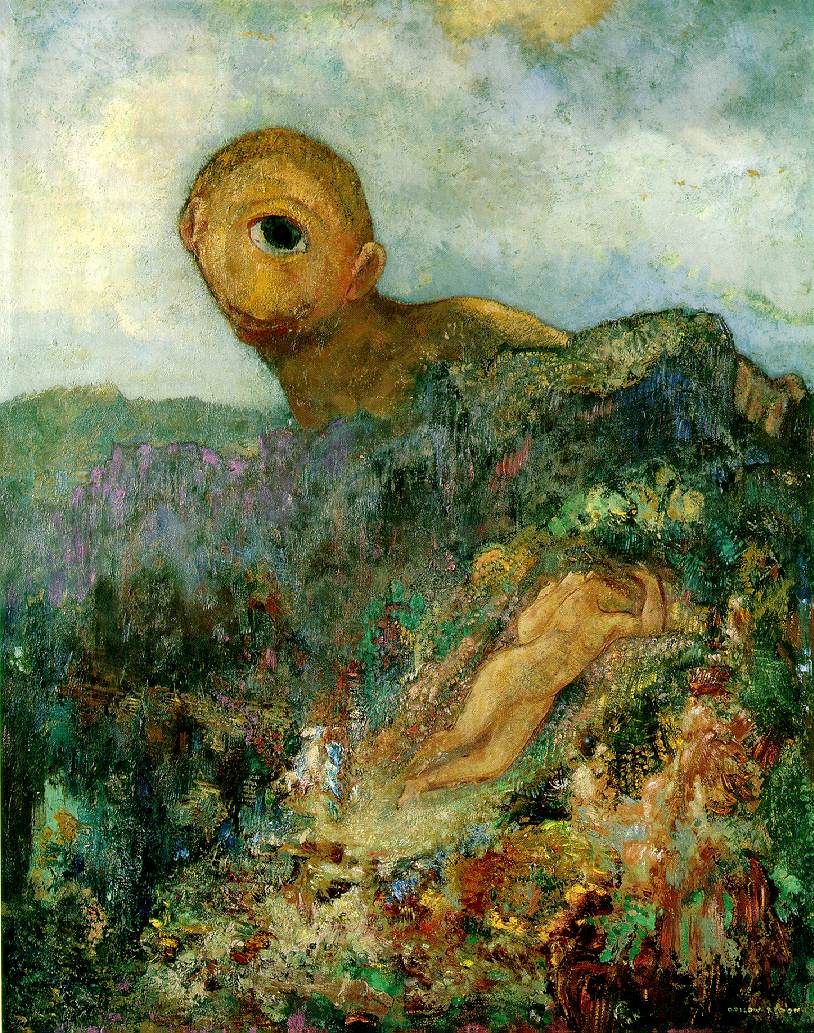
By Absolute, of course, is meant that the work's value is not engaged with the associations of its subject matter.  I have often wondered whether it was that Raphael print, given to me as a reward for perfect attendance at Sunday School, that put me on the way to specializing in Greek art.  I have learned to appreciate all sorts of illustrative art, often illustrative of literature or expressive of mystical ideas, as with Odilon Redon, or even political ideas or the spirit of an age, like the railway stations and social life in Manet and the Impressionists, but the Absolute works have conditioned the way I see them.
What most interests me is understanding why, when almost all the rest of humanity is interested in art as illustrating or standing for something else, and in discussing or explaining art betray their way of seeing it (even to the point of explaining Edward Weston's Peppers sexually, just to cite one), a few of us, myself included, have become formed, without any special training (and indeed over the objections of Sunday School teachers in the case of Tintoretto's Susannah and the Elders, the Vienna painting when it was on tour in the USA), to enjoy almost all art for its absolute qualities, feeling that I see the artist's own mind, even admitting that our Norman Rockwell, at his best, can be taken as an artist more than as an illustrator.  Is the tendency innate?
And I'd like to propose that differentiating the absolute qualities in visual and musical and poetic works is worth thinking about.  Who wants to be distanced from Sumerian and Greek, from Chinese and Islamic, and any other works of visual art simply because they may represent or illustrate cultural beliefs different from one's own?  Who doesn't want to have the pleasure of understanding why Chardin's painting of a boy blowing soap bubbles is as much more satisfying than any Dick and Jane illustration of soap bubbles as Raphael's Madonna is than what usually comes on a commercial Christmas card?

It is so difficult to write clearly enough!
P.S. But, key idea, non-objective and absolute are not the same idea.  Some artists have been more than others inclined to the Absolute, though.  Go to Art Project (see above) and think about it.  It is not formal emphasis, either, that governs Poussin, but his own vision that governs his own use of it.
It's like, the statement Rose is Rose is Absolute, but a rose placed on a wedding altar is a symbol of something else, and "Roses of Picardy" is a song less about roses than about the sadness following World War I.
Chardin's boy blowing soap bubbles is in the Metropolitan Museum in NY, and you can just Google that subject.  It is a good example of a painting with absolute values dominating that sells like hot cakes for its subject matter's associations.